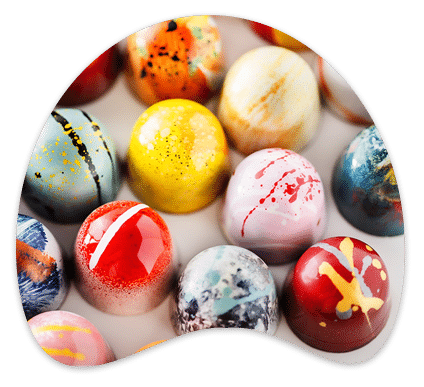
Our Salted Caramel is the best-selling bonbon in the shop. It is also the one that took the longest to land. Eleven recipe attempts over four months before we had something we'd put our name on. Here is the short version of what failed, what worked, and the moment I knew version 11 was the one.
What we wanted
The target flavour was: a clean bitter chocolate shell (72% Ecuadorian) that gives way to a soft, slow-flowing caramel, with a hit of salt at the very end that doesn't taste like a seasoning but like a discovery. The caramel itself should be the colour of dark amber. The salt should be visible on the surface but not crunchy in the mouth.
Versions 1-4: too sweet
The first four versions used a basic wet caramel: sugar, water, cream, butter. The flavour was fine, but every single one tasted like a caramel candy. We wanted something more grown-up — a caramel that tasted like it had been cooked by someone with a point of view, not by a factory. The problem was sugar: at the ratios I was using, the caramel was 70% sugar by weight. There's no way around that with a wet caramel.
Versions 5-7: too dry
Switched to a dry caramel (no water, sugar cooked directly in the pan) and reduced the cream. This got the sugar percentage down to about 55%, but the caramel started to crystallise on cooling, which meant the bonbons had a grainy texture. Tried adding a touch of glucose syrup to prevent crystallisation, but that pushed the flavour back toward the candy end. Burned two batches in a row at 180°C because dry caramel has zero margin for error — you have about 90 seconds between "perfect amber" and "smoke alarm."
Versions 8-9: too dark
Took the dry caramel darker — to 200°C — thinking that more caramelisation would equal more depth. The flavour was incredible in the pan. In the bonbon, it was overcooked, almost bitter. The 72% shell was already bitter, and the two bitters compounded instead of contrasting. Also tried using brown butter (beurre noisette) in the cream, which was delicious in version 9 but made the caramel seize when added to the hot sugar. The texture was lumpy.
Version 10: almost
This was a hybrid: dry caramel cooked to 175°C, deglazed with hot cream that had been infused with vanilla, finished with Normandy butter off the heat. The texture was finally right. The flavour was 90% there — but the salt on top tasted like salt, not like a discovery. I'd been using Maldon, which is a finishing salt, but the flakes were too big and too punchy. They were sitting on top of the chocolate like seasoning instead of melting into the flavour.
Version 11: the one we kept
Two changes from version 10. First, I switched the salt from Maldon flakes to a fine Halifax flake salt — same provenance (Nova Scotia), but milled finer so it melts on the tongue instead of crunching. Second, I painted a thin layer of cocoa butter on the top of each bonbon before dusting the salt on, so the salt is suspended in a layer of fat rather than sitting on the chocolate surface. The cocoa butter was a trick I'd seen on French pastry work — it gives the salt a vehicle so it can carry into the flavour rather than announce itself.
The first batch of 60 came out of the tempering room on a Friday morning in February 2024. I ate one. The salt hit at the back of the tongue, exactly where I wanted it, and it lasted about two seconds — long enough to register, short enough that the next bite of caramel could come in clean. I called Aline over. She ate one. She said, "That's it." I made four more batches that week. We've shipped over 12,000 of them since.
What I'd do differently
Honestly? Not much. The 11 attempts were the right number. Versions 1-4 taught me what sugar ratio I was working with. Versions 5-7 taught me that texture matters as much as flavour. Versions 8-9 taught me that "more" isn't always better. Version 10 got me 90% of the way there. The salt and the cocoa butter were the last 10%, and I would not have arrived at them without the 10 attempts that came before. If I tried to write the recipe now, I could probably get there in 3 versions. But I wouldn't trust my own recipe until I'd run it 11 times.
The Salted Caramel is $7 per piece, or $54 for a 9-piece box. You can order it here.